
consent - your right to say yes, no, and tell me more
- Team Naked Doula

- May 21
- 4 min read
Updated: May 22

Nobody tells you this clearly enough at the start of pregnancy, so here it is:
You have the legal right to accept or decline any intervention from any healthcare professional. This applies during pregnancy, during labour, and during birth. It is not a courtesy. It is not something that depends on whether your midwife is having a good day. It is the law, grounded in the principle of autonomy, and upheld by the 2015 Montgomery ruling.
What that means in practice: NOTHING should happen to YOUR body without your INFORMED CONSENT.
What informed consent actually means
There's a difference between being told something is happening and genuinely consenting to it.
True informed consent means a healthcare professional has explained what they want to do, why, what the risks are, what the alternatives are, and you've agreed based on that. Consent given under pressure, without full information, or in a hurry without time to think, is not valid consent.
Two examples worth sitting with:
A vaginal examination should not happen without your healthcare provider explaining exactly what it involves and getting a clear yes from you first. Not assumed. Not implied by the fact that you're already in the room.
"We're just going to pop a clip on the baby's head" is not informed consent for a fetal scalp electrode.
That clip is attached by a small spiral screwed into your baby's scalp. You should be told that, what it is, how it works, why they're recommending it, and what happens if you say no.
If something is being done to you that hasn't been properly explained, you can stop and ask. Mid-examination, mid-conversation, at any point. You don't need to wait for a pause.
Pregnancy and the anxiety fog
Here's the honest part. Pregnancy can make it harder to think clearly. The instinct to protect your baby is enormous, hormones are shifting, anxiety is common and the medical system has a long history of quiet compliance behind it. Most women don't push back. Most women don't know they can.
Your midwife and doctors are there to give you unbiased, non-coercive information. They can present evidence from studies and their hospital policies. They can make recommendations. What they cannot do is make decisions for you, or present only one option as though it's the only option.
You are also entitled to ask for a second opinion at any point. That is not difficult or disruptive. It is a normal part of informed care.
Use B.R.A.I.N.
When something is being recommended and you want to think it through - in pregnancy, in labour, anywhere - this is the tool. It works because it slows things down and makes everyone stop and think about what you want, not just what they think you need.
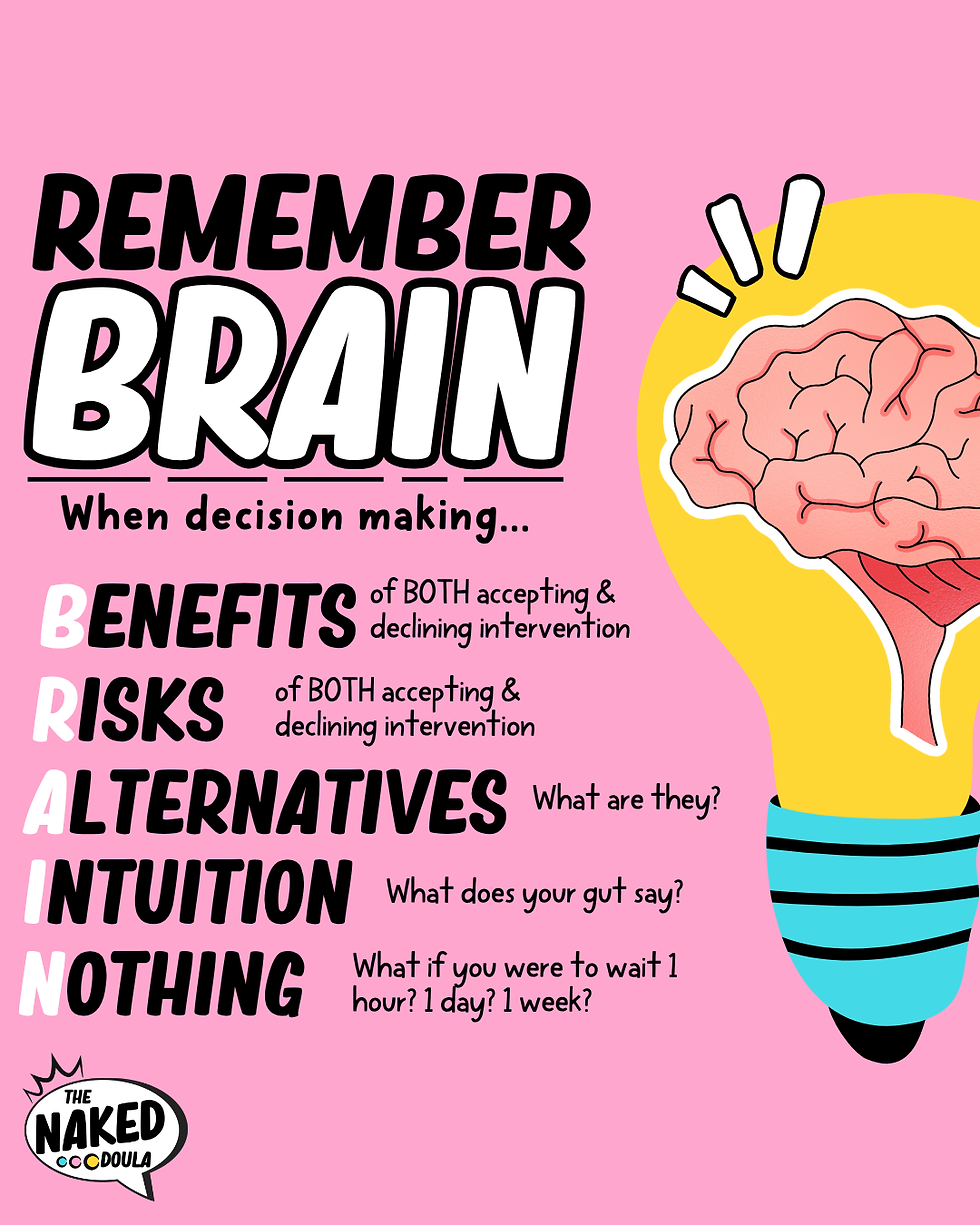
B = Benefits - What are the benefits of what you're suggesting? To me, to the baby, right now?
R = Risks - What are the risks? Ask for the actual statistics, not just the word "risk." Numbers are more useful than labels.
A = Alternatives - What are the alternatives to what you're recommending? There is almost always more than one option.
I = Intuition / Information - Do I need more information before I decide? Time to think? A second opinion?
N = Nothing - What happens if we do nothing right now? Is this genuinely urgent, or is there time?
That last one matters more than it sounds. If you feel like you're being led towards a decision - ask directly: is this an emergency? Sometimes it clearly is. Sometimes it isn't, and the question alone gives everyone a moment to step back.
It goes beyond medical procedures
Physiological birth is not a medical event. Your autonomy covers your environment, not just your body.
If you want more birth partners than the unit "allows", ask why. Is there a clinical reason? Is it a genuine risk assessment, or a number in a policy that nobody has questioned? Could a different unit - a midwife-led unit, a birth centre, a home birth - give you what you need? Your healthcare team should support you in exploring those options, not close them down.
In labour, it gets harder
Advocating for yourself mid-contraction is genuinely difficult. Your birth partner has a role here - knowing your preferences in advance and being willing to ask questions on your behalf when you can't.
A birth plan does two things: it forces you to think through what you want while you're calm enough to think, and it communicates that clearly to everyone in the room when you're not.
From The Naked Doula


the short version
You can say no. You can ask why. You can ask for the statistics. You can ask for a second opinion. You can ask if it's an emergency. You can change your mind.
None of that makes you difficult. All of it is your right.
Full reading: aims.org.uk - making decisions and birthrights.org.uk - consenting to treatment
Sources
AIMS - Making Decisions in Pregnancy. aims.org.uk/information/item/making-decisions
Birthrights - Consenting to Treatment. birthrights.org.uk/factsheets/consenting-to-treatment
Supreme Court - Montgomery v Lanarkshire Health Board [2015] UKSC 11


Comments